
Release Notes for the Alternative Fueling Station Locator
Learn about new features and updates released for the Alternative Fueling Station Locator, including the web application, the iPhone app, the Android app, the data download tool, and the API for web developers. These release notes begin with features published in 2024. For questions about previous updates, contact us.
Station Locator Redesign: Mobile, Maps, and Faster Results
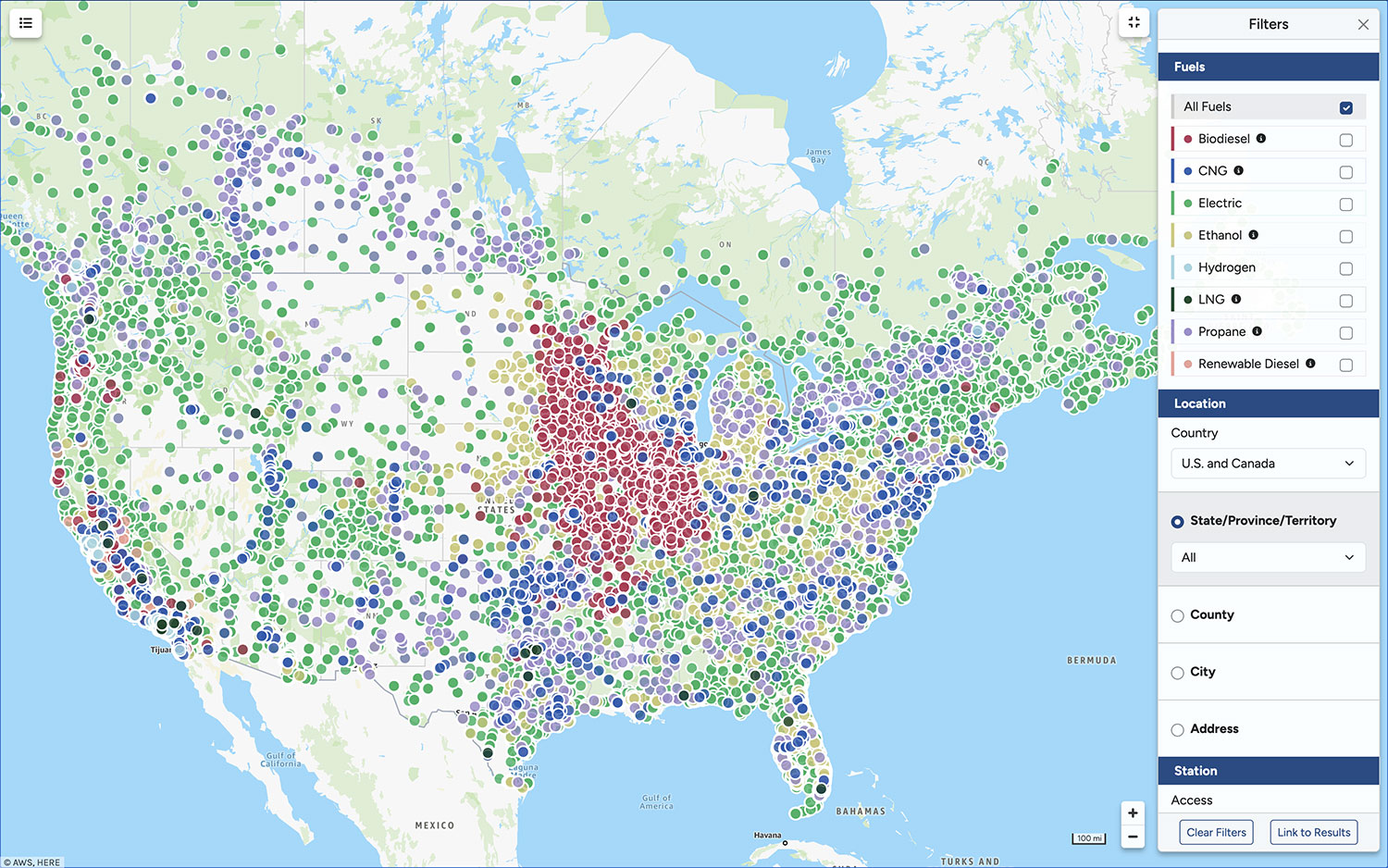
July 2026The Station Locator user interface has been redesigned to deliver faster searches, improved mobile usability, richer map visualization, expanded filtering, and new access to historical station data.
This release is a major redesign of the Alternative Fueling Station Locator to better support the growing volume and complexity of alternative fueling and EV charging station data. As the most-used tool on the Alternative Fuels Data Center—receiving about 4.5 million pageviews and 32,000 data downloads each year—this update is intended to help users find stations more quickly, interpret results more easily, and share data more effectively.
Key enhancements in the redesigned Station Locator include a more modern, mobile-friendly interface; improved map visualization to better handle overlapping stations as station density increases; and performance improvements that enable quicker searching and filtering. The update also adds new ways to explore and use the data, including historical station views and additional geographic filters.
Highlights of this release include:
- Streamlined, unified filters to support faster, more intuitive searches
- Improved visualization of overlapping stations to better represent dense infrastructure areas
- New geographic filters for city and county to enable more targeted results
- Historical station views to help track infrastructure and market trends over time
- Optimized mobile experience to better support users on the move
- Enhanced search options, including searching by landmarks (for example, national parks)
- Modernized database structure aligned with Open Charge Point Interface (OCPI) protocol to support future interoperability and data partnerships
Improved Open Dates for API-Imported Stations
February 2026The Station Locator has an updated approach for setting open dates for stations imported from EV charging network APIs to prevent planned stations from having inaccurate open dates.
The Station Locator now has refined logic for setting open dates for API-imported EV charging stations to improve accuracy in the data. Previously, a station’s open date was set to the first date the station appeared in a network API feed—unless the network provided an explicit open date. This approach sometimes resulted in planned (not yet operational) stations receiving an open date even though they were not yet available to the public.
To address this, the Station Locator now sets the open date only when a station’s status changes to available or temporarily unavailable for the first time. This update improves the accuracy of open dates for API-imported stations and better distinguishes planned locations from stations that have entered service.
Standardized EV Charging Port Structure
January 2026To improve consistency and prepare for an upcoming database redesign, the production data model now has a new paradigm for EV charging ports. Charging data is now structured so each charging unit contains only one charging port, which helps standardize how port-level details are represented across the dataset.
API Documentation Published for Related Stations
December 2025API documentation is available now for a new API field that provides a list of related stations. This field is intended to help API users understand relationships between similar stations (for example, nearby stations that are represented in the data as separate stations but are functionally considered a single station). This API field will support a new feature in an upcoming release of the Station Locator.
New API Documentation for Charging Networks, Charging Ports, and Filters
August 2025To improve support for web developers and increase data usability, the stations API documentation now covers additional features, including the charging networks endpoint, charging ports endpoint, the funding sources filter, and the facility type filter.
New Advanced Filter for Facility Type
August 2025The Station Locator now includes an advanced filter that allows users to search for stations by facility type, and the station details pages now display facility type for stations where this information is available.
Megawatt Charging System (MCS) Connector Type and Filter
July 2025The Station Locator now tracks Megawatt Charging System (MCS) sites by adding a new SAE J3271 connector type to the stations database and providing a corresponding connector filter in the Station Locator.
To support emerging medium- and heavy-duty electric vehicle charging needs, the Alternative Fueling Station Locator now includes a new connector type—SAE J3271—to identify stations that use the Megawatt Charging System. This update makes it possible to find MCS-capable charging stations through the Station Locator map and data downloads.
The Station Locator user interface now includes an MCS (J3271 DC) connector filter, allowing users to more easily find stations equipped with MCS hardware. This enhancement helps fleet managers, alternative fuel corridor planners, and other stakeholders quickly locate high-power charging options as MCS deployment expands.
Updated Status Handling for Temporarily Unavailable Stations
June 2025For API-connected EV charging networks, the Station Locator now changes stations that remain in a “temporarily unavailable” status for more than six months to “unavailable,” removing them from public visibility in the Station Locator.
To improve data quality and reduce confusion for users, the Station Locator now applies a new rule for stations from EV charging networks that provide station status via API. If a station remains in the “temporarily unavailable” status for more than six months, it is automatically switched to “unavailable,” which means it will no longer appear in the Station Locator. If the status of the station switches to “available” again, the station will be visible in the Station Locator again.
This update helps ensure that stations shown in the Station Locator more accurately reflect locations that are expected to be operational again while limiting the display of sites that may be offline indefinitely or no longer in service.
Electric Vehicle Charging Networks Metadata
January 2025A new page on the AFDC helps users understand the concept of electric vehicle charging networks and how they are represented in the Station Locator. This page provides definitions for network terms, information on the methods for collecting data to populate the Station Locator, and details about how and when data are imported from each charging network.
Funding Sources for Electric Vehicle Charging Ports
December 2024Building on the funding sources feature published in July 2024 for tracking federal funding at the station level, the Station Locator database can now track federal funding sources like NEVI, CFI, and EVC-RAA at the charging port level.
Previously, it was only possible to track funding sources at the station level. This enables showing which ports are funded by specific programs to provide an accurate number of EV charging ports with these funding mechanisms. This includes tracking funding sources for the National Electric Vehicle Infrastructure (NEVI) Formula Program, the Charging and Fueling Infrastructure (CFI) Discretionary Grant Program, and the Electric Vehicle Charger Reliability and Accessibility Accelerator (EVC-RAA).
Updated Vehicle Class Ranges for Medium- and Heavy-Duty Filters
October 2024The Station Locator’s fleet type/max vehicle class options were updated so medium-duty includes classes 3–6 and heavy-duty includes classes 7–8, aligning with Federal Highway Administration (FHWA) definitions.
The Station Locator’s fleet type and max vehicle class options are updated to clarify how vehicle classes map to medium- and heavy-duty vehicle categories. Medium-duty now includes classes 3 through 6, and heavy-duty includes classes 7 and 8. This change addresses prior confusion about why class 6 vehicles appeared under a heavy-duty selection when FHWA defines heavy-duty as classes 7 and 8.
Power Output Data for Electric Vehicle Charging Stations
July 2024The Station Locator now provides power output data for electric vehicle (EV) charging stations to help people understand how quickly a vehicle can charge. Most of the data provided is rated maximum power capacity in kilowatts.
In response to frequent requests from EV charging infrastructure stakeholders, the Station Locator now provides power output data for EV chargers. This dataset can help EV drivers, transportation planners, and analysts understand how much charge can be achieved within a certain duration.
Developing this new capability included collecting data from the EV charging networks and EV charging site hosts. Most of the data provided is rated maximum power capacity in kilowatts, but in some instances, actual power supplied is provided. Future work on this dataset will entail standardizing whether maximum power or actual power data is tracked.
The power output data is available on each station details page, and you can search for stations by power output ranges in the advanced filters.
Funding Source for Electric Vehicle Charging Stations
July 2024The Station Locator now shows which electric vehicle (EV) charging stations were installed with funding from the National Electric Vehicle Infrastructure (NEVI) Formula Program.
The Station Locator has a new field to track the funding source for stations. This new feature was launched to make it possible to see EV charging stations funded by NEVI. In the future, this field will be used to track other key federal funding sources for stations like the Charging and Fueling Infrastructure (CFI) Discretionary Grant Program as well as the Electric Vehicle Charger Reliability and Accessibility Accelerator (EVC-RAA).
Android Mobile App Version 2.0
July 2024A new version of the Android mobile app provides more station details and makes it possible to suggest new stations and changes for existing stations.
The latest version of the Android mobile app is an overhaul that aligns the mobile app features with those offered in the website version. Previously, the Android mobile app was developed as a separate application, which meant that keeping features in sync with the website version was laborious and inefficient. The new version is a mobile view of the website so new features added to the Station Locator can be made available in the Android mobile app seamlessly.
Notably, the Android app now includes the ability to submit new stations or suggest changes for existing stations as well as additional details like vehicle accessibility and fuel types like renewable diesel and whether the station sells renewable natural gas. Some features like advanced filters and measuring alternative fuel corridors are excluded from the mobile version intentionally so the app is optimized for mobile devices with features people need the most on the go.
Chart of Historical EV Charging Port Counts
April 2024A new chart of EV charging infrastructure growth on the Joint Office of Energy and Transportation's website provides an interactive way to see how the landscape for EV charging in the United States has changed since 2021.
Improved Form for Adding and Updating Stations
April 2024A revamped form in the Station Locator for suggesting a new station or updates for existing stations enhances the quality of the data and reduces the time spent processing submissions to make data available in the tool faster.
The updates to the form for adding and editing a station were focused on gathering more complete and more accurate information so the data collection team can process station submissions faster, including adding a series of fields that existed in the database but were not on the form yet. Key improvements included:
- A new approach for entering EV charging connector types and power output by connector
- New fields for:
- Access restrictions (for public stations)
- Point of contact
- Type of vehicles allowed (for fleet fueling facilities)
- Largest vehicle type (ability to access the station)
- Propane sufficient fill rate
- Renewable propane sold or dispensed
- More required fields:
- Status
- Business hours (for public stations)
- Charging level
- Charging ports by level
- Charging network
- CNG dispensers installed
- Propane nozzles
- Hydrogen pressure
- Hydrogen SAE standards compliance
Data Download Filters for Country and Temporarily Unavailable Stations
February 2024The stations data download now has more filter options available for country and station status.
The stations data download has a new country filter to select stations only in the United States or Canada. Previously, U.S. and Canadian stations were both included by default in all data downloads, which caused confusion for some people, so this explicit filter by country makes it clear what the data download provides. In addition, the data download tool also includes a new option in the status filter for “temporarily unavailable” stations. Previously, you could only include those stations by selecting the "All" option from the status filter.
Historical Stations Data Download
January 2024The Station Locator now provides historical station data as far back as 2014 that can be used to analyze the growth of alternative fueling and EV charging infrastructure over time.
The historical stations data download provides a snapshot of stations in two views:
-
Single Day: Provides a list of published station locations on a given date.
-
Date Range for Specific Station(s): Provides a list of changes that occurred in the database for a given list of one or more station locations that were published at some point within a given date range.
The station counts by state page also now includes an option to view counts on a given day as far back as 2014. For more details about the historical stations data, learn about the information included in the data download.